Attic mold in Southern California homes is most commonly caused by inadequate roof ventilation combined with the region’s marine layer humidity, HVAC duct leaks that deposit warm humid air into the attic space, or roof leaks that go undetected for weeks because Southern California’s dry climate makes homeowners less likely to inspect their attic after a rain event — and because attic mold is entirely invisible from the living spaces below, most LA County homeowners only discover it during a home sale inspection, after a persistent musty odor develops throughout the house, or when mold growth becomes extensive enough to stain visible roof decking.
Attic mold is the mold discovery that surprises people the most. In a region where homeowners associate mold with damp basements and rainy climates, finding an active mold colony in a Southern California attic feels counterintuitive. But Long Beach, Lakewood, Torrance, Carson, and the broader LA County coastal communities have a specific climate profile that makes attic mold more common than most homeowners realize — and the consequences of leaving it unaddressed extend from structural wood damage to legitimate habitability concerns under California law.
Why Southern California Attics Are More Susceptible to Mold Than You’d Expect
Mold requires three things to grow: a food source (wood, insulation, dust), a temperature between 40°F and 100°F, and moisture. The first two are present in every attic in LA County. The moisture variable is where Southern California’s specific climate profile creates conditions that most homeowners don’t anticipate:
Marine Layer Humidity
Long Beach, Signal Hill, Lakewood, Carson, Torrance, and the coastal communities of LA County experience the marine layer — low coastal fog and high relative humidity that moves inland from the Pacific, most pronounced from late May through early August in what locals call “May Gray” and “June Gloom.” During marine layer periods, nighttime and morning outdoor relative humidity in Long Beach regularly reaches 85 to 95%. An attic with inadequate ventilation traps this humid air, which condenses on the cooler surfaces of roof decking and rafters overnight. Over weeks of this cycle, wood moisture content rises into the range that supports mold growth — even without a single drop of rain.
Inadequate or Obstructed Roof Ventilation
Attic moisture is managed through continuous ventilation: air enters through soffit vents at the eave line and exits through ridge vents or roof vents at the peak, carrying humidity out of the attic space. Many homes in Long Beach and the surrounding communities — particularly those built in the 1950s through 1970s — were constructed with inadequate ventilation ratios or with ventilation systems that have since been compromised:
- Attic insulation blown or laid over soffit vents, blocking airflow at the eave
- Ridge vents covered during a reroofing without replacement
- Gable vents that were sealed during attic conversion or expansion
- Ventilation ratios (typically 1:150 to 1:300 of attic floor area) that were below standard for the original construction era
When ventilation is obstructed, moisture that would otherwise be carried out of the attic accumulates — and the marine layer makes this problem significantly worse than it would be in an inland climate.
HVAC Duct Leaks in the Attic
In Southern California homes, HVAC air handlers and ductwork are frequently located in the attic space rather than in a basement or conditioned mechanical room. When supply or return ducts develop leaks at joints, connections, or from aging duct board, conditioned air escapes into the attic. In summer, cold supply air mixing with hot attic air creates condensation on duct surfaces and surrounding materials. In winter, warm return air escaping into a cooler attic adds moisture that the ventilation system may not be able to keep up with. HVAC-related attic mold is particularly common in homes where the ductwork has not been inspected or maintained in 10 or more years.
Undetected Roof Leaks
California’s long dry periods create a specific roof leak problem: minor roof failures — cracked flashing around plumbing vents, deteriorated pipe boot seals, or lifted ridge cap shingles — don’t produce enough water intrusion during normal dry months to cause interior ceiling staining. When the first significant rain arrives, water enters the attic through these failures, soaks the insulation and roof decking, and then — because the next dry period follows quickly — appears to dry out before the homeowner has noticed anything inside. This cycle repeats with each rain event, progressively building moisture content in attic materials until mold establishes. By the time visible symptoms appear inside the home, the attic may have extensive mold growth that has been developing for one to three years.
Post-Wildfire Ash and Particulate Infiltration
Following significant fire events in LA County — including the 2025 Palisades and Eaton fires — ash and fine particulate infiltrate HVAC systems and attic spaces throughout the region. This particulate contains nutrients that support mold growth and can clog ventilation pathways in attic spaces, reducing the airflow that keeps moisture levels in check. Homeowners in the greater Long Beach area who experienced significant ash deposition during fire events should consider having their attic assessed for both particulate accumulation and any associated mold growth.
Signs You May Have Mold in Your Attic
Because attic mold is invisible from living spaces, the early signs are indirect:
- A musty or earthy odor that is strongest in the top floor of the home, in a specific room below the attic, or when the HVAC system runs. HVAC systems draw air through return vents that may communicate with the attic, which can pull mold spore-laden air into the living space.
- Unexplained allergy or respiratory symptoms in household members that improve when they leave the home and return upon coming back — a pattern clinically associated with indoor mold exposure.
- Ceiling staining or discoloration that returns after painting, or that appears near a plumbing penetration, HVAC equipment access point, or skylight frame.
- Discovery during a pre-sale home inspection. Attic mold is one of the most common findings in LA County real estate transactions, and it is a required disclosure under California Civil Code §1102. Discovering it during an inspection rather than proactively is more expensive and more disruptive — both to the transaction and to the remediation process.
- Recent roof repair or replacement that revealed deteriorated decking or dark staining on the underside of sheathing panels.
What Attic Mold Looks Like When Found
Attic mold in Southern California homes most commonly appears as:
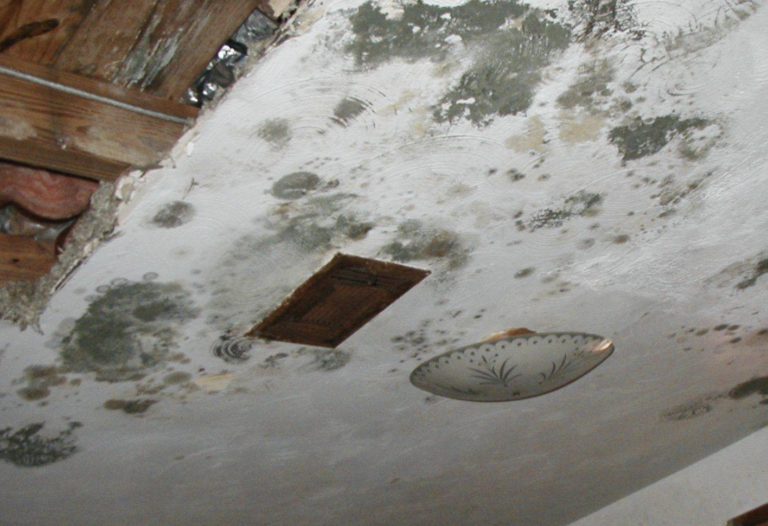
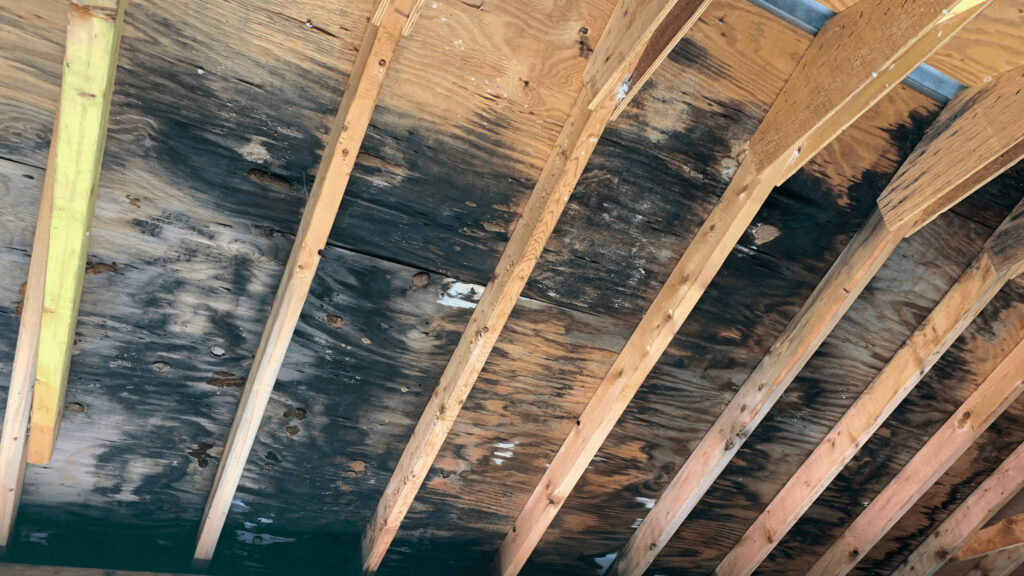
- Dark black or greenish-black staining across the underside of roof sheathing panels — often covering large areas of decking when discovered
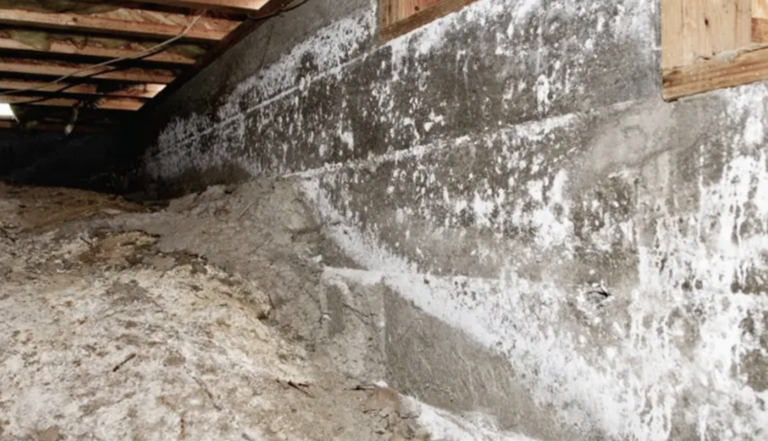
- White or gray fuzzy growth on wood rafters and joists, particularly where insulation contacts the wood
- Dark staining or surface growth on the paper facing of batt insulation
- Discoloration around HVAC equipment mounting brackets, duct connections, and around plumbing vent penetrations through the roof deck
Mold color is not a reliable predictor of species or hazard level — black mold can be several different species, most of which are not Stachybotrys (the species most commonly associated with severe health effects). All active mold growth in an attic space warrants professional assessment and remediation regardless of color or apparent coverage.
California Law and Attic Mold
California Health & Safety Code §17920.3 defines visible mold growth that is not caused by condensation as a substandard housing condition. For rental properties in Long Beach and across LA County, landlords are legally required under this statute and California Civil Code §1941 to maintain rental housing free of conditions that materially affect habitability — which courts have consistently interpreted to include mold.
For homeowners selling property in California, the Transfer Disclosure Statement (TDS) requires disclosure of known mold. A home with professionally remediated and documented attic mold is in a significantly better position in a real estate transaction than one where mold is either undisclosed or discovered during inspection with no remediation history.
What Attic Mold Remediation Involves
Assessment and Moisture Source Identification
Professional attic mold remediation begins with identifying and confirming the moisture source — because mold removal without source correction always recurs. A thorough assessment includes moisture meter readings of roof sheathing and framing, inspection of all ventilation pathways, evaluation of duct condition and potential leak points, and inspection of all roof penetrations for flashing integrity. This assessment report is also what your insurance adjuster or real estate transaction requires as documentation.
Containment
The attic work area is contained to prevent spore migration into the living spaces below during remediation. Access points to the attic are sealed, and negative air pressure is maintained during the remediation process using HEPA-filtered air scrubbers.
HEPA Vacuuming and Surface Preparation
All loose mold-contaminated material is removed and bagged. Insulation that is mold-contaminated or that was in direct contact with affected surfaces is removed — it cannot be cleaned effectively and must be replaced.
Antimicrobial Treatment and Encapsulation
Affected structural surfaces — roof sheathing, rafters, and framing — are treated with EPA-registered antimicrobial agents applied by brush or spray. Where surface mold has etched into the wood surface, an encapsulant is applied after treatment to lock in any residual staining and prevent re-contamination from the existing surface. This is not a substitute for actual mold removal — it is a final protective step applied to fully treated surfaces.
Ventilation Correction
If inadequate or obstructed ventilation was identified as the moisture source, ventilation correction is completed before the attic is re-insulated. This may involve clearing blocked soffit vents, installing additional roof vents, or replacing ridge vent material. Correcting the moisture source is what makes the remediation permanent.
Insulation Replacement
New insulation is installed to current California energy code standards after the structural surfaces have been treated, dried, and confirmed clear. In LA County, attic insulation to R-38 is the standard for residential construction.
Does Homeowners Insurance Cover Attic Mold in California?
Coverage depends on the cause. Attic mold that developed as a direct result of a sudden, covered water event — a storm-damaged roof that allowed water intrusion, or an HVAC condensate line failure that soaked the insulation — is generally covered under the same claim as the original water damage event. California homeowners policies typically include a mold coverage limit (often $5,000 to $10,000) that applies to mold resulting from covered water losses.
Attic mold that developed gradually — from inadequate ventilation over time, from a slow roof leak that the homeowner didn’t address, or from condensation accumulation — is generally categorized as a maintenance issue and not covered. The distinction can be contested, and the documentation your restoration company provides regarding the moisture source is what determines which side of that line the claim falls on.
For more on California mold law and insurance coverage, see our guide: California Mold Laws: What Renters and Homeowners Need to Know.
Jackson Restoration: Attic Mold Removal Across Long Beach and LA County
Jackson Restoration provides professional attic mold assessment and remediation across Long Beach, Lakewood, Torrance, Carson, Compton, Downey, Signal Hill, Wilmington, and LA County. Our certified mold remediation team identifies the moisture source, removes contaminated materials, treats structural surfaces, corrects ventilation deficiencies, and restores the attic to pre-mold condition — with complete documentation for insurance claims and real estate disclosures.
Contact us to schedule an attic assessment — particularly if you’re preparing to sell, if you’ve noticed unexplained odors or respiratory symptoms, or if your home experienced a roof leak or significant HVAC issue in the past few years. Learn more about our attic and crawl space mold services and our broader mold remediation process.