Hardwood floor water damage becomes permanent within 24 to 72 hours — once wood planks begin to cup, buckle, or separate from the subfloor, no amount of drying will restore them to their original state. Whether you’re dealing with a burst pipe, an appliance leak, or flooding from a storm in the Long Beach area, the actions you take in the first few hours determine whether your floors can be saved or need to be replaced.
This guide walks you through exactly what happens to hardwood floors when they get wet, how to read the warning signs, and when to call a water damage restoration professional before the damage becomes irreversible.
Why Hardwood Floors Are Especially Vulnerable to Water
Wood is a hygroscopic material — it absorbs and releases moisture from the surrounding environment constantly. Under normal conditions, this is manageable. But when a large volume of water contacts hardwood flooring, the outer surface absorbs moisture far faster than the interior can equalize. That imbalance is what causes the structural damage you see.
In Southern California, this vulnerability is compounded by two local factors. First, most Long Beach and LA County homes are built on slab foundations, meaning there’s no crawl space beneath the floor for moisture to escape — water has nowhere to go but into the wood and the concrete beneath it. Second, the coastal humidity common in Long Beach (especially during May and June gloom) slows the natural evaporation process once flooding occurs, giving water more time to penetrate deeper into the wood grain and the adhesive layer beneath engineered planks.
The Three Stages of Water Damage in Hardwood Floors
Stage 1 — Swelling and Surface Staining (0–24 Hours)
In the first few hours, hardwood planks begin absorbing moisture at the surface. You may notice slight swelling along the plank edges, surface staining or discoloration, and a soft or spongy feel underfoot in the affected area. At this stage, professional drying can usually save the floor — but the clock is already running.
Stage 2 — Cupping (24–72 Hours)
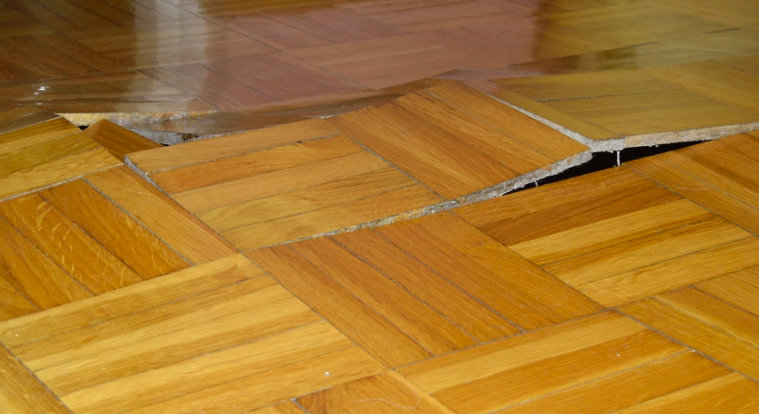
Cupping is the most recognized sign of hardwood water damage. It occurs when the bottom of the plank absorbs more moisture than the top, causing the edges to rise higher than the center. The floor begins to look wavy or corrugated. Solid hardwood can sometimes be sanded flat after cupping if caught at this stage and dried properly. Engineered hardwood is more difficult to recover once cupping sets in.
Stage 3 — Buckling and Separation (72+ Hours)
When hardwood floors are left wet beyond 72 hours, planks lose their structural integrity. Buckling occurs when the wood expands to the point where it physically lifts away from the subfloor, sometimes by several inches. Gaps open between planks. Adhesive bonds fail. At this point, replacement is almost always the outcome, and the damage often extends to the subfloor as well — adding significant cost to the restoration.
Common Causes of Hardwood Floor Water Damage in Long Beach and Los Angeles County
Understanding what caused the water intrusion matters because it affects both the restoration approach and your insurance claim. The most frequent sources we see across the Long Beach and Greater LA area include:
- Appliance supply line failures — Refrigerator water lines and dishwasher hoses are among the most common culprits. These slow leaks often go undetected for days or weeks before visible floor damage appears.
- Water heater tank failures — A 40–80 gallon tank that ruptures or develops a slow leak at the base can saturate an entire room before it’s noticed.
- Upstairs neighbor leaks — In Long Beach’s many multi-unit buildings and condo complexes, water from a neighbor’s unit above can seep through ceilings and reach hardwood floors below. If you’re dealing with this situation, our guide on water damage from an upstairs neighbor covers your rights and next steps under California law.
- Atmospheric river flooding — Increasingly common in Southern California, heavy rain events can overwhelm drainage and send water through exterior doors, garage transitions, and low-lying entries.
- Plumbing supply line breaks — While freeze-related pipe bursts are rare in LA County, older galvanized and copper supply lines in Long Beach’s aging housing stock are prone to failure under pressure.
What to Do Immediately When Hardwood Floors Get Wet
The goal in the first hour is simple: stop the water and remove as much moisture as possible before it penetrates deeper.
- Shut off the water source. If a pipe or appliance caused the leak, locate the shutoff valve and stop the flow. For a refrigerator water line, pull the appliance out and close the saddle valve behind the wall. For a burst pipe, use your home’s main shutoff.
- Remove standing water immediately. Use towels, a wet/dry vacuum, or a mop to pull as much surface water off the floor as possible. Every minute of standing water counts.
- Move furniture and rugs. Area rugs trap moisture and dramatically slow the drying process. Furniture legs left on wet hardwood will leave permanent staining and accelerate cupping in that spot.
- Increase air circulation. Open windows if outdoor humidity is lower than indoor humidity. Run ceiling fans. A household box fan aimed at the affected area helps — but it is not a substitute for professional-grade air movers.
- Call a restoration company. Hardwood floor water damage is one of the situations where waiting even a few additional hours changes the outcome. Professional equipment — industrial desiccant dehumidifiers, high-velocity air movers, and moisture meters — operates at a completely different level than anything available at a hardware store.
Can Water-Damaged Hardwood Floors Be Saved?
The honest answer: sometimes. The factors that determine whether restoration is possible include how long the floor was exposed, how deep the moisture penetrated, the wood species and plank thickness, and whether the subfloor is also saturated.
Floors that can typically be saved share these characteristics: the water was removed within 24–48 hours, cupping is present but buckling has not yet occurred, moisture readings show saturation is limited to the top layer, and there are no signs of mold beginning beneath the planks.
Floors that typically require replacement show visible buckling or separation, subfloor saturation (confirmed with moisture meters), structural adhesive failure in engineered installations, or mold growth beneath the surface — which brings its own remediation requirements. If mold remediation becomes part of the scope, that needs to be addressed before any flooring reinstallation.
What Professional Hardwood Floor Water Damage Restoration Looks Like
When our team arrives at a Long Beach home, the first step is always a full moisture assessment. We use thermal imaging cameras and calibrated moisture meters to map exactly where the water has traveled — including areas that look dry to the eye but are holding moisture in the subfloor or wall cavities.
From there, the drying plan is built around that moisture map. Industrial air movers are positioned to create targeted airflow across the affected area, while desiccant dehumidifiers pull moisture out of the air faster than the wood can re-absorb it. Daily moisture readings track the drying curve and confirm when structural dryness has been reached — typically 3 to 5 days for moderate water damage, longer for severe cases.
Throughout the process, we document everything: moisture readings, equipment placement, daily logs, and photographs. This documentation is your evidence file if you’re filing a homeowner’s or renter’s insurance claim.
How Much Does It Cost to Restore Water-Damaged Hardwood Floors in Los Angeles County?
Cost depends heavily on the scope: how many square feet are affected, whether the subfloor needs treatment, and whether any flooring needs to be replaced rather than restored. As a general rule, professional drying and restoration of an isolated area (a kitchen or hallway, for example) costs significantly less than full floor replacement — which is exactly why early intervention pays for itself. For a detailed breakdown of what water damage restoration costs in the LA area, see our guide on water damage restoration costs in Los Angeles.
Will Your Insurance Cover Hardwood Floor Water Damage?
Most homeowner’s and renter’s insurance policies cover water damage that is sudden and accidental — a burst pipe or appliance failure, for example. Gradual leaks that develop over time (a slow-dripping supply line that’s been leaking for months) are typically excluded as a maintenance issue. The documentation we provide during restoration is critical for your claim: adjusters need proof of the cause, the scope, and the drying timeline. For more on how California water damage claims work, see our guide on renters insurance and water damage in California.
Frequently Asked Questions
Can cupped hardwood floors be fixed without replacement?
Yes, in many cases. If the wood is dried to its equilibrium moisture content and the cupping is not severe, the planks will often flatten back out naturally over several weeks. Sanding can then address any remaining height variation. Floors that buckle, however, almost always require replacement.
How long does it take to dry hardwood floors after water damage?
With professional equipment, structural drying typically takes 3 to 5 days for moderate water damage. Severe cases involving subfloor saturation can take 7 to 10 days. Attempting to dry with household fans alone can take weeks — during which mold growth is likely to begin under the floor surface.
Is there mold under my water-damaged hardwood floors?
Mold can begin to develop within 24 to 48 hours in the right conditions — particularly in Southern California’s warm temperatures. Hardwood floors trap moisture against the subfloor, creating an ideal environment. If your floors were wet for more than 48 hours, a professional moisture and mold assessment is advisable even if the surface looks dry.
What’s the difference between engineered hardwood and solid hardwood in a water damage situation?
Solid hardwood (typically 3/4 inch thick) is more resilient because it can be sanded and refinished multiple times. Engineered hardwood has a thin veneer over a composite core that is more sensitive to moisture and delamination. Both can be saved if water is addressed quickly, but engineered hardwood has a narrower window before permanent damage occurs.
Contact Jackson Restoration for Emergency Hardwood Floor Water Damage in Long Beach
If your hardwood floors are wet right now, don’t wait until tomorrow. Jackson Restoration provides 24/7 emergency water damage restoration in Long Beach, Lakewood, Bellflower, Cerritos, Signal Hill, and throughout LA County. The sooner we can get moisture readings and equipment in place, the better the outcome for your floors.
Contact us immediately for a same-day response — we’ll assess the damage, explain your options, and work directly with your insurance company from day one.